Why we built it
Every audio deepfake vendor publishes an accuracy figure clustered around 99%. None of those numbers are comparable: each is computed on a test set the vendor controls, at a threshold the vendor controls, on attack distributions that may or may not mimic what an attacker would actually deploy in 2026.
The closest thing the field has to a public standard, ASVspoof 2019 LA, is a snapshot of TTS attacks that predates ElevenLabs, F5-TTS, Chatterbox, and the rest of the modern voice-cloning stack. Detectors trained on it do not generalize to current threats.
We needed three things at once that no existing benchmark gave us:
- Private labels. A vendor cannot tune against a test set it cannot read.
- A modern attack distribution. The synthetic side has to reflect what attackers are actually shipping in 2025.
- Realistic format diversity. Production audio arrives as mp3, m4a, webm — not just 16 kHz wav.
A neutral benchmark for audio deepfake detection
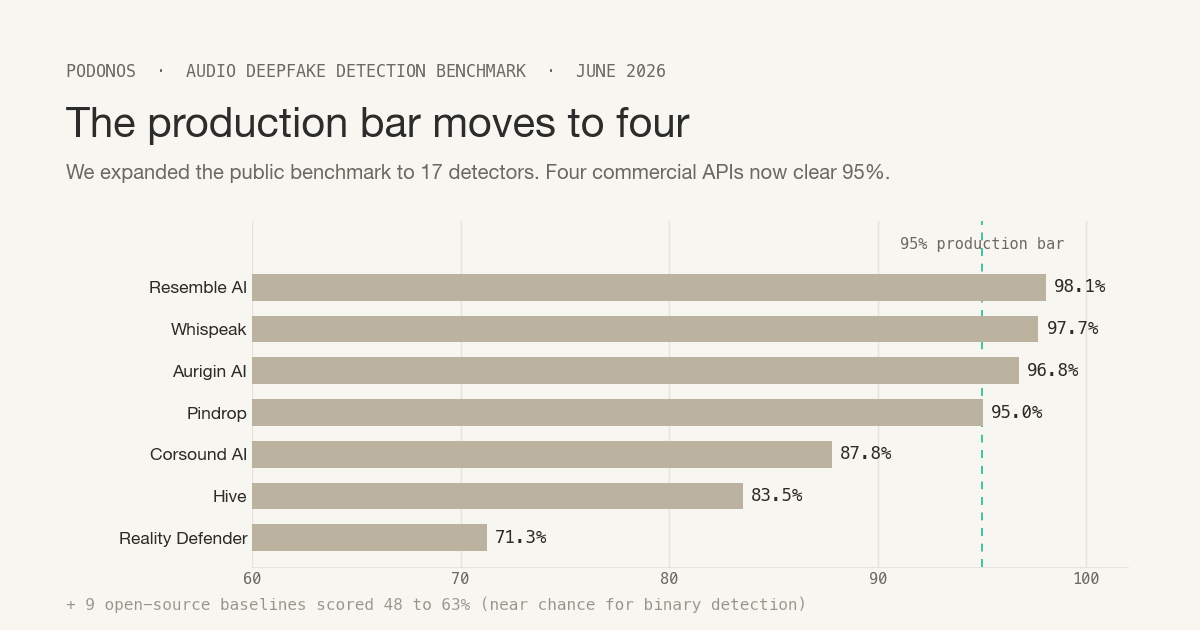
Resemble AI and Aurigin AI both clear 96% accuracy on a fixed, format-rich, private-label test set. Their error profiles are different — and the right choice for your deployment depends on whether catching fakes or avoiding false alarms is more critical to your use case.
What is in the data
- Real audio: VCTK (110 UK English speakers), LJSpeech (single voice), LibriTTS-360 (904 speakers).
- Synthetic audio: ~25 modern TTS systems including ElevenLabs, F5-TTS, and Chatterbox. Every clip is round-trip verified through OpenAI Whisper to ensure the TTS system actually synthesized the intended utterance.
- Six file formats: mp3, wav, flac, ogg, m4a, webm. Performance is reported per format — detectors leaning on codec artifacts reveal themselves in the breakdown.
- Class balance is 50/50 real vs. fake across 4,524 audio clips. The gold-standard labels stay private to keep the benchmark honest.
We deliberately do not report Equal Error Rate. EER assumes you can pick the operating threshold; in production you ship at the threshold the vendor ships with.
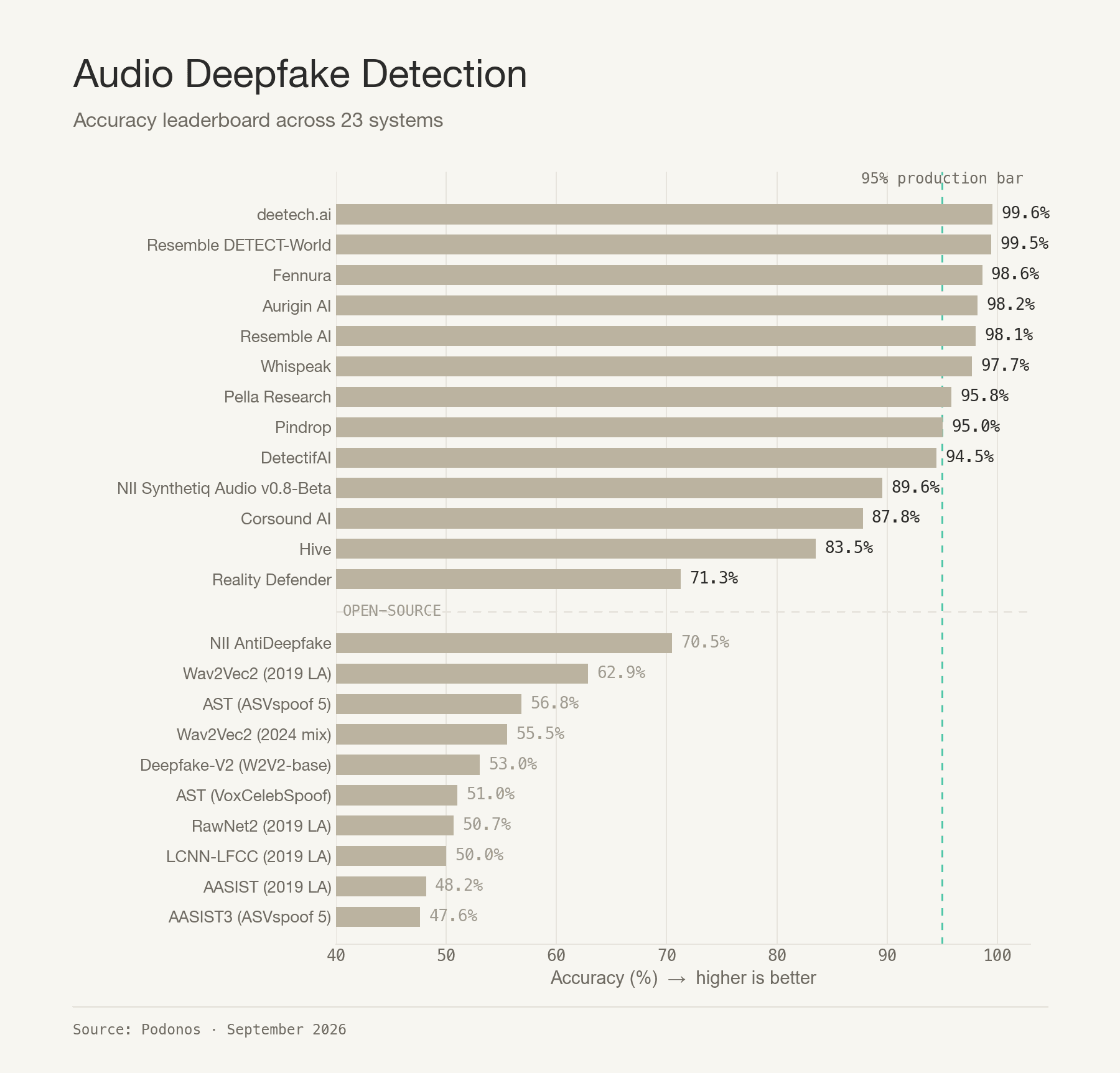
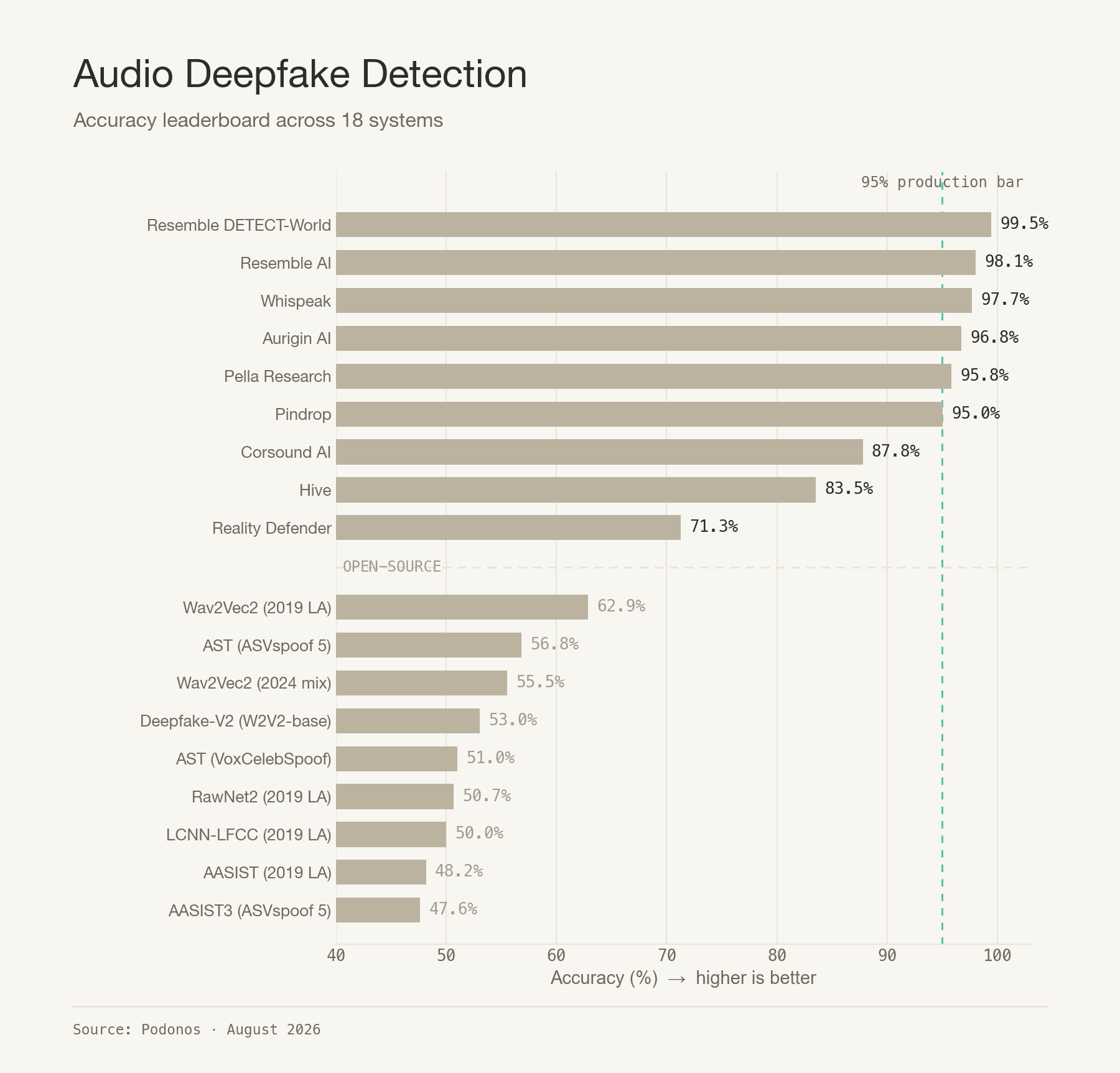
Results
Repo: https://github.com/podonos/audio-dfd-benchmark
Three observations
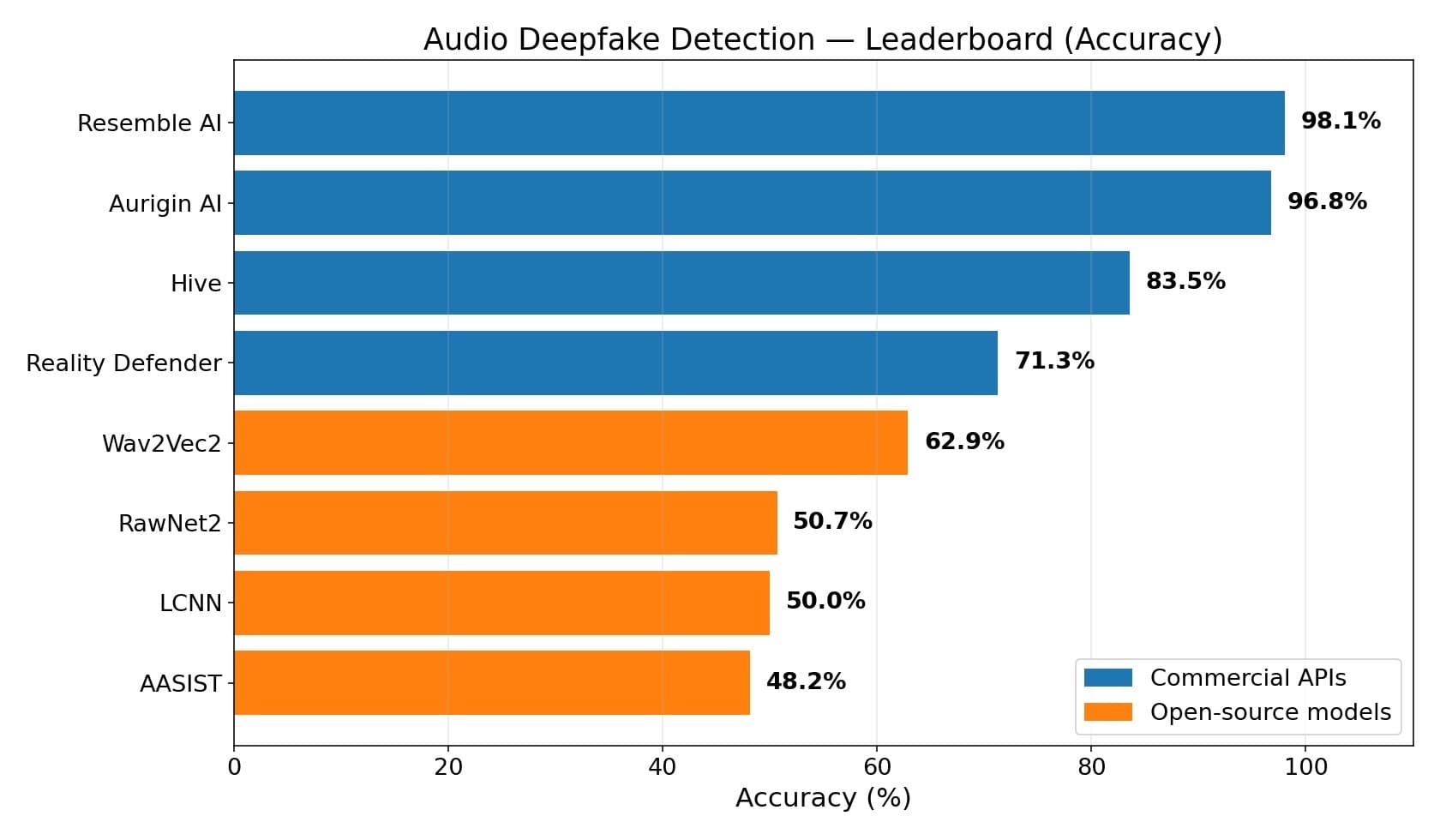
Resemble AI and Aurigin AI both lead the field — they are similarly strong, with different shapes.
Resemble AI lands at 98.05% accuracy with a 1.4% false negative rate (it almost never misses a fake) and a 2.5% false positive rate. Aurigin AI lands at 96.75% accuracy with a 1.5% false positive rate (it almost never wrongly flags real audio) and a 5.0% false negative rate. Both are production-grade, both clear F1 0.96+. The gap between them and the rest of the field is enormous: more than 13 percentage points to #3.
The open-source baselines collapse.
All four of Wav2Vec2, RawNet2, LCNN, and AASIST were trained on ASVspoof 2019 LA, and all four score between 48% and 63% on this dataset — barely better than random. LCNN simply predicts "fake" for every input. The pattern is not really about open-source vs. commercial; it is about the obsolescence of ASVspoof as a training distribution.
Reality Defender's profile is unusual.
71.3% accuracy, 53.7% false-positive rate (it flags more than half of real audio as fake), 17.2% rejection rate (clips under 1.5 seconds are not evaluated), and a real-time factor of 1.52 (slower than real-time).
Which error matters more for you?
The most useful chart for buyers is the trade-off between false positives and false negatives. The two leaders sit at opposite corners of it.
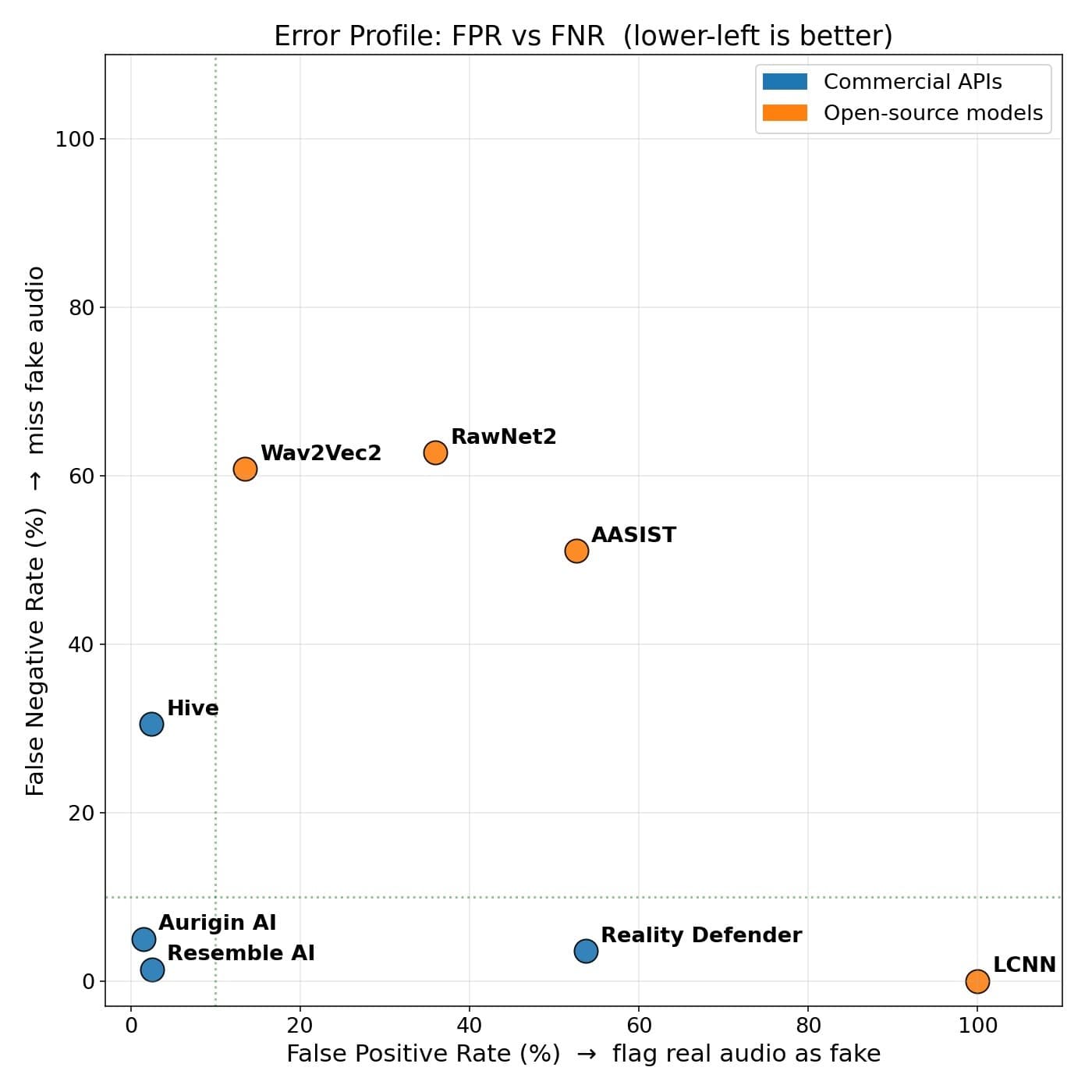
Resemble AI and Aurigin AI are similarly good. The choice between them is a choice between error profiles, not between products:
- Voice-fraud screening, KYC, content provenance: missing a fake is the most expensive error. Lower FNR wins Resemble AI.
- Content moderation at scale, automated takedowns, journalism verification: false-flagging real users is the most expensive error. Lower FPR wins Aurigin AI.
Most teams should evaluate both on a representative slice of their own traffic. Beyond raw accuracy, check whether each vendor can customize model sensitivity to match your error-tolerance profile.
Latency matters too
Streaming and real-time use cases need a real-time factor below 1.0. Reality Defender at 1.52 fails this bar regardless of accuracy. The open-source models are fast (RTF 0.006–0.14) but, as the leaderboard shows, do not work on the data. Resemble AI and Aurigin AI both land near RTF 0.33–0.40, well within real-time budgets.
Caveats
- English-only. Non-English voice cloning is real and we do not have a read on it yet.
- Snapshot in time. The TTS landscape is moving quickly. We plan to refresh the synthetic side regularly.
- We hold the labels. Unavoidable for the design to work; every other component (data construction, request schemas, scoring code) is inspectable.
Links
- Repo: https://github.com/podonos/audio-dfd-benchmark
- Related work:
- Commercial APIs evaluated: Aurigin AI, Resemble AI, Hive, Reality Defender.
- Open-source baselines: AASIST, RawNet2, Wav2Vec2, LCNN-LFCC.
To submit a detector, drop a predictions.csv in the format documented in the repo. We are happy to score it against the held-out labels and publish the result.